Quality
Software
Services
Support
Are you already a client? Go to your personal space
Industries
About us
Resources
Waiting for complete design drawings before starting tolerance modeling can cut analysis time short and increase project risk.
To begin earlier, Vladimir Till, Dimensional Engineer at HELLA Automotive, and his team built a database of ISO-standard process tolerances to apply to their CAD models before official design release tolerances were available, using 3DCS to find critical quality areas, contributors, and high-risk assemblies early.
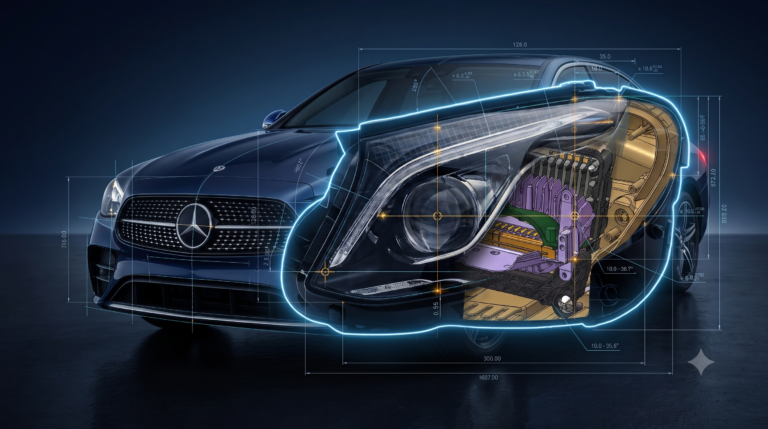
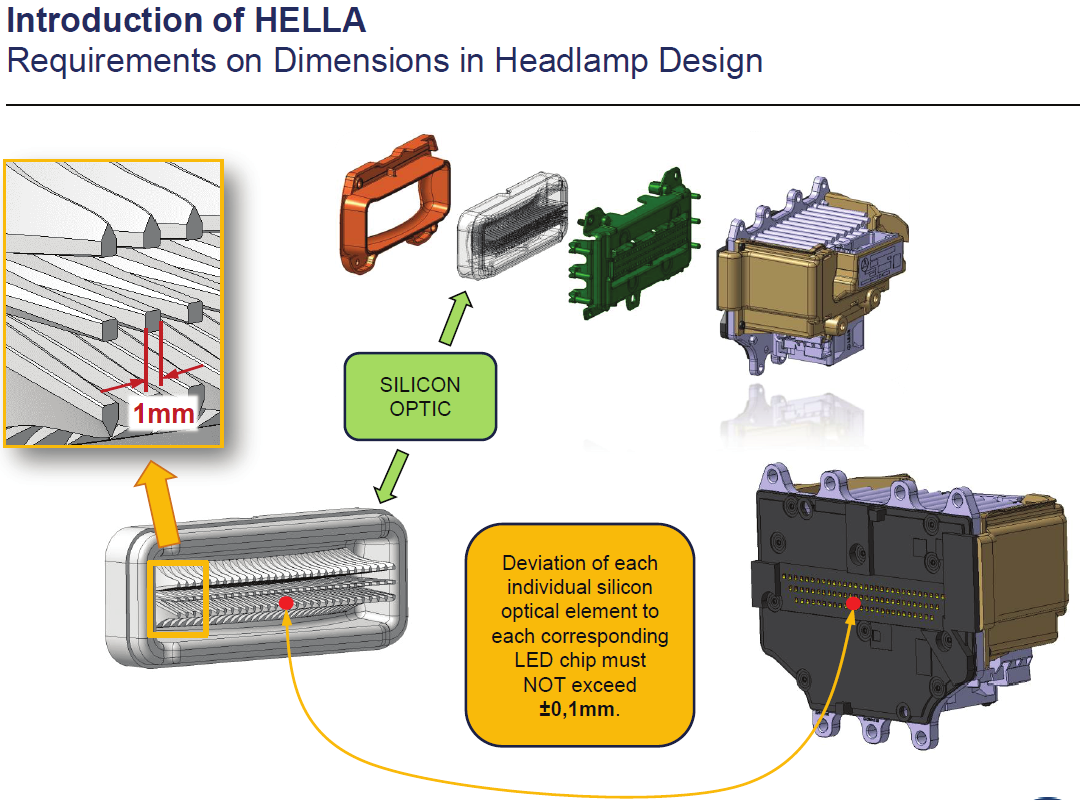
The stakes are high on complex assemblies such as the Mercedes-Benz E-Class Matrix HD84 headlamp, where each of the 84 individual LED optical elements must align to its corresponding LED chip within ±0.1 mm. To manage this precision without waiting on final drawings, HELLA automated ISO tolerance creation directly into 3DCS, saving many hours of manual input.
HELLA applies ISO-standard process tolerances to CAD models directly in 3DCS, finding critical quality areas, contributors, and high-risk assemblies before official design tolerances are available.
A custom Excel / Visual Basic tool built by HELLA’s dimensional engineering team exports points and automatically creates ISO-standard tolerances for direct import into 3DCS, cutting manual input time and reducing the risk of human error.
HELLA models and runs tolerance simulations in 3DCS before official drawings are released, using an ISO-standard tolerance database to identify critical quality areas, contributors, and high-risk assemblies early.
On the Mercedes-Benz E-Class Matrix HD84 headlamp, HELLA controls the alignment of each of the 84 individual optical elements to its corresponding LED chip within a ±0.1 mm deviation, managed directly in 3DCS.
A custom tolerance generator built by HELLA automates ISO-standard tolerance creation and imports it directly into 3DCS, saving many hours of manual input and reducing the risk of human error.
Simulation results give HELLA data-backed arguments when negotiating tolerances with customers and suppliers, helping avoid unnecessarily tight, costly specifications without compromising build quality.
Because models are already toleranced to ISO standards, HELLA can quickly update and rerun 3DCS analyses once final design release drawings arrive, delivering final study results without delay.
"*" indicates required fields
Vladimir Till has worked as a Dimensional Engineer at HELLA, a German automotive supplier, since 2010. Speaking about his team’s use of 3DCS, he describes a shift from two-dimensional stack-up calculations to full three-dimensional variation simulation. Watch the full interview above.
The complexity of the model has grown alongside the software. With Compliant Modeler, Till’s team can now incorporate part deformation directly into their tolerance studies, adding another layer of realism to their simulations.
For Till, the real value of 3DCS shows up in conversations with customers, suppliers, and designers. When a customer asks for an overall tolerance of ±0.3 mm, for example, his team can break that figure down into every contributing process and part tolerance behind it.
That transparency changes the nature of the conversation: instead of contesting a single number, HELLA and its partners can look at the same data, understand where the risk comes from, and decide together whether a tolerance should be held tight or relaxed.

Too many correction loops? The Manufacturing Quality Pack is now live.
OUT NOW : Inspection Flow is live. Centralize your metrology data and close the quality loop.