Ensuring conformance of automotive interior and intuitive controls with 3DCS

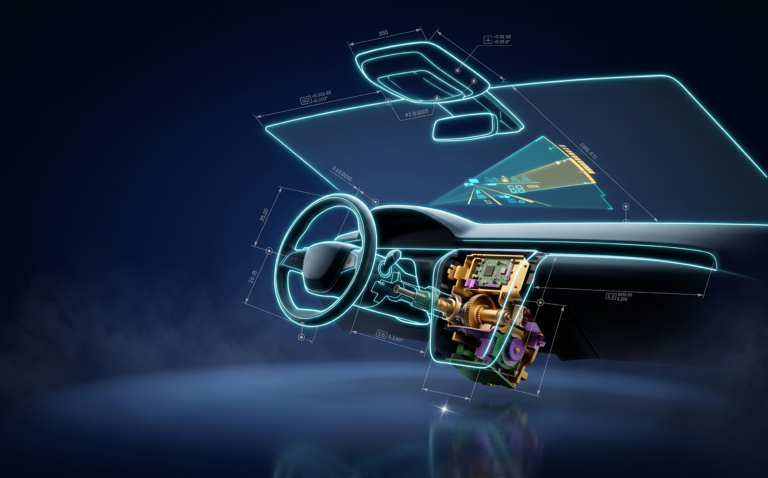
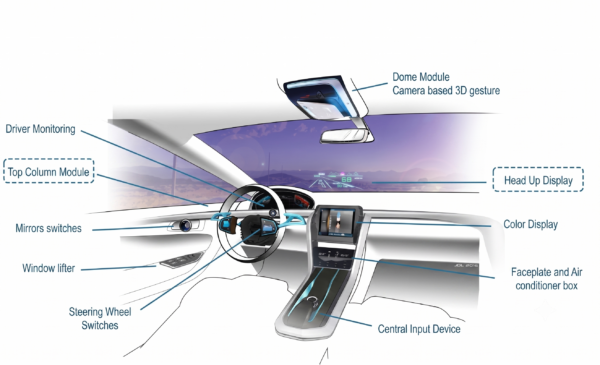
At its India R&D center, automotive supplier Valeo uses 3DCS Variation Analyst to control variation in systems usually thought immune to it — from the densely packed controls of the steering-column Top Column Module to the optics of the Head-Up Display projected onto the windshield.
100%
of current TCM contact-safety requirements simulated in 3DCS
5
optical contributors modeled for the Head-Up Display
0
pixel loss targeted on the windshield projection
2
product families validated: steering-column controls & Head-Up Display

The Industrial Challenge

Sadiq Ali Basha G, Deputy Manager for Comfort and Driving Assistance systems at Valeo India — the R&D center of automotive supplier Valeo — set out to control the performance of systems normally considered unaffected by variation, using advanced GD&T and tolerance analysis techniques. The Top Column Module (TCM), the steering-column section behind the wheel, packs directional switches, levers, ring rotators and rocker switches into very little space.

Why variation matters here

With so many controls condensed into one device, variation becomes a decisive factor in final builds — every switch, lever and ring must land safely on the correct contact pad for its function to occur.

The same discipline had to reach the Head-Up Display (HUD), where an imager projects onto a reflector and then onto the windshield. Slight angular changes to the projector or the reflector shift or distort the image, so the optical team needed the projection to stay inside the best-fit zone at optimal resolution — without any pixel loss.

Integrated Technology Synergy

3DCS Variation Analyst Metrologic DCS
Up-front variation analysis to predict and eliminate build issues

3DCS Variation Analyst let Valeo run up-front assembly build analyses, simulate every probable configuration and identify conditions where safety specifications were not satisfied — then optimize contact-pad design to meet the Design Rule for all configurations.

3DCS Mechanical & Contact Modeling Metrologic DCS
Range-of-motion and contact simulation for complex mechanisms

Levers, ring rotations and rocker switches were simulated in each position and for combinations of activations, so that iterative control of variation guaranteed proper function of every control across its full range of motion.

All current requirements for contact safety of TCMs are simulated in 3DCS.
Sadiq Ali Basha G
Deputy Manager, Comfort & Driving Assistance Systems

Operational Impact & Results

Robust contact-safety approach established

A repeatable method was defined to simulate contact safety of TCMs despite their complex mechanical architecture.

All configurations evaluated

Every probable configuration was assessed to identify the conditions under which safety specifications were not satisfied.

Contact-pad design optimized

Simulation results drove optimization of the contact pads, helping meet the Design Rule across all configurations.

Head-Up Display optics safeguarded

3DCS results fed the optical team's design of the projection chamber, guaranteeing beam projection and preventing pixel loss from optical-cone variation.

Method extended to new products

The approach was applied beyond the steering column to the HUD, which requires composite spatial tolerance analysis.

Best practices documented

Guidelines were prepared for modeling complex junctions such as plunger-to-3D-ramp contacts and deformable contact wipers.

Ready to master variation in complex assemblies?
Our experts help you deploy 3DCS tolerance analysis to validate contact safety, mechanism function and optical performance before you cut steel. Book a 1-on-1 consultation.

From steering column to Head-Up Display

Valeo first established a robust approach for contact-safety simulation of TCMs with their complex mechanical architecture, then extended it to other products such as the Head-Up Display, which requires composite spatial tolerance analysis. 3DCS simulation results were handed to the optical team as inputs to design the critical parts of the projection chamber, including maximum translations and tilts.

Next step: thermal effects

Because Valeo must test products at extreme temperatures (-40°C to +80°C), the team’s next objective is to bring thermal effects into variation analysis — a natural extension of their digital twin and simulation practice with 3DCS.

Explore how other automotive leaders leverage Metrologic DCS to solve complex dimensional challenges.
A tolerance analysis project ahead?
Talk to a 3DCS specialist about simulating variation, contact safety and optical tolerances in your assemblies.

"*" indicates required fields

This field is for validation purposes and should be left unchanged.
Optin*
* By submitting this form, I agree to receive the case study and occasional industrial insights and product updates from Metrologic DCS. I can unsubscribe at any time.

Too many correction loops? The Manufacturing Quality Pack is now live.

OUT NOW : Inspection Flow is live. Centralize your metrology data and close the quality loop.