Quality
Software
Services
Support
Are you already a client? Go to your personal space
Industries
About us
Resources
Jaguar Land Rover’s Dimensional Variation Analysis (DVA) team is part of the Dimensional Control and Build Integrity group within Advanced Manufacturing Engineering. It supports every vehicle line, analysing body structures, trim and final, interior, powertrain and chassis.
Its initial Design Intent models are built from generic “Design Variation” standards — often before part drawings exist — to represent the dimensional capability of parts, assemblies and processes.
As demands and criticality across JLR’s vehicles increased, those generic assumptions were no longer accurate enough. The team needed a modelling strategy that stayed true to design intent yet incorporated real measurement data to enhance accuracy — and fed improvements back to continually raise the design standards through rigorous GD&T analysis.
JLR builds Design Intent models in 3DCS to simulate assembly variation, validate datum structures and predict dimensional issues across the full vehicle.
The QDM Web system centralises measurement data company-wide, feeding real manufacturing capability back into the simulation loop.
QDM PDA delivers advanced statistical process control, letting the DVA team separate true dimensional capability from process noise.
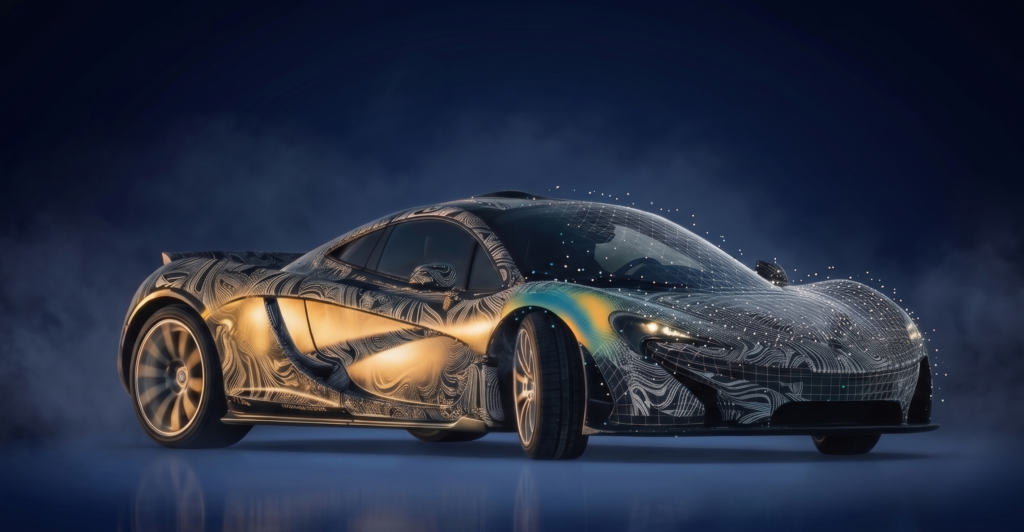
3DCS simulation and QDM measurement data combine to solve dimensional issues both before and during production.
Substituting Design Intent assumptions with real QDM data makes models reflect actual manufacturing influences.
Refinements feed back into the generic Design Variation standards, benefiting every subsequent program.
Global measurement data feeds a quality maturation cycle across all JLR vehicle lines.
Simulation results are correlated with measured build data to confirm and mature designs.
"*" indicates required fields
Presented by Jon Tongue and Paul Gilbert at the DCS Global Technology Conference, JLR’s approach combines simulation tools with manufacturing quality data to correlate designs with real production results. The closed-loop process uses 3DCS and the QDM Web system to simulate, create measurement plans, measure, and solve issues both before and during production.
Where a Design Intent model lacks sufficient accuracy, a refinement process incorporates QDM data and feeds it back to the Design Variation standards. By substituting generic assumptions with measured capability — less the noise — the model reflects the real manufacturing environment and delivers higher-accuracy results.
Too many correction loops? The Manufacturing Quality Pack is now live.
OUT NOW : Inspection Flow is live. Centralize your metrology data and close the quality loop.