Quality
Software
Services
Support
Are you already a client? Go to your personal space
Industries
About us
Resources
Airbus’s dimensional management team has long been recognized for a rigorous tolerance management process that improves quality and reduces the risk of non-conformance.
But as Airbus expands manufacturing and compresses development cycles to meet growing global demand, the team needed a way to validate assembly strategies and tooling before physical parts exist — delivering it “right the first day.”
Airbus’s Dimensional Variation Analysis (DVA) objectives were clear: simulate the product as closely as possible, including FEA analysis; identify key characteristics and areas requiring improvement; optimize tolerance chains and assembly strategies; and communicate analysis results clearly enough to act on in both development and manufacturing.
Building and validating a separate model for every aircraft configuration risked slowing the team down rather than speeding it up — the team needed models that could be reused and parameterized across product families.
Airbus uses 3DCS Variation Analyst to build 3D tolerance and assembly simulations based on concept studies and datum systems that respect real assembly strategies and manufacturing capabilities. Because the models are parametric, a single model can cover multiple configurations — up to 180 assembly situations across the A319, A320 and A321 section joints — instead of rebuilding an analysis for every variant.
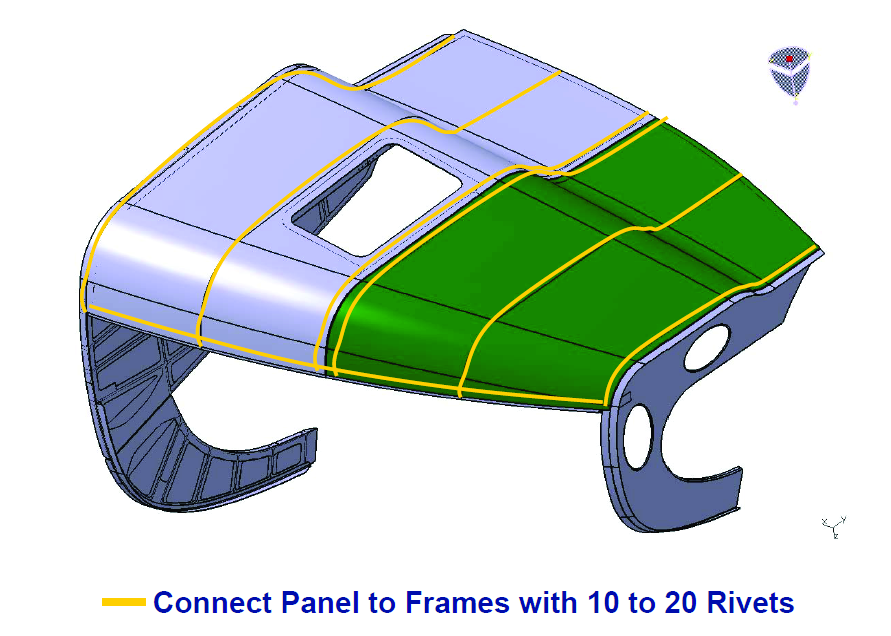
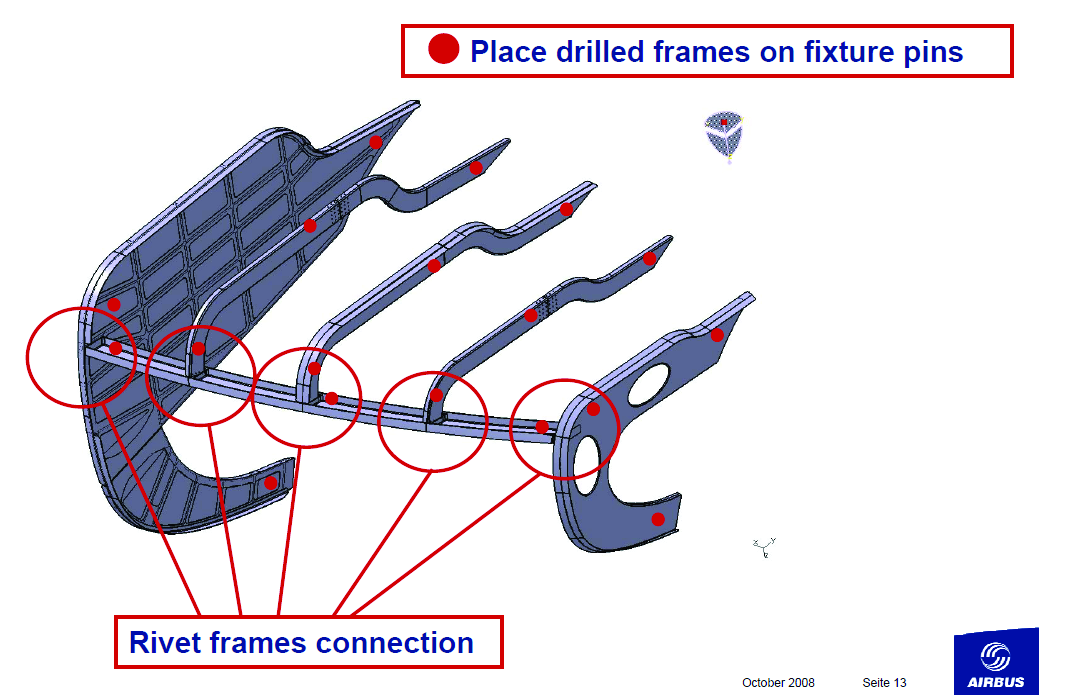
To better represent the realistic state of the product, Airbus incorporated Finite Element Analysis into its dimensional management process. Multi-stage modeling in 3DCS captures how rivets, tooling and fixtures deform outer aircraft panels during assembly, informing decisions on rivet placement, machine pathing and sequencing based on overall variation impact.
A single model built once handles the equivalent of 180 distinct section-joint assembly scenarios across the A319, A320 and A321, avoiding redundant remodeling for each configuration.
Roughly 60 of the 90 stringer couplings in a typical A320 Family section are covered by the parametric model, reducing manual setup effort for new configurations.
From defining geometric requirements to validating results, Airbus's dimensional management team follows a defined process that connects engineering, manufacturing and quality assurance.
Finite Element Analysis is combined with 3DCS multi-stage modeling to simulate rivet and panel deformation on outer aircraft skins, improving the accuracy of predicted final part position.
"*" indicates required fields
Too many correction loops? The Manufacturing Quality Pack is now live.
OUT NOW : Inspection Flow is live. Centralize your metrology data and close the quality loop.