Quality
Software
Services
Support
Are you already a client? Go to your personal space
Industries
About us
Resources
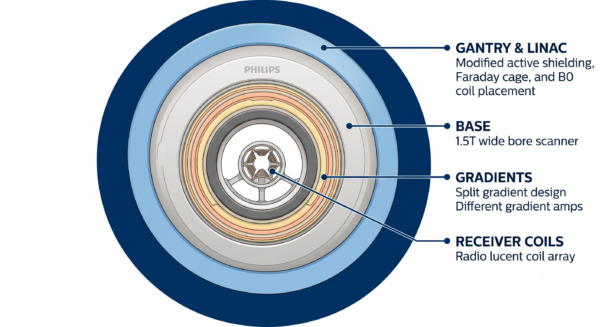
Philips Medical partnered with a radiation therapy provider to merge two systems that are traditionally kept apart — MRI scanning and high-dose radiation treatment — into a single device: the MR-Linac.
The goal was to track organ position in real time and deliver directed radiation beams straight into cancerous cell clusters.
Combining these systems created unique engineering problems. The radiation beam projected into the patient had to stay consistent and uniform to guarantee the correct treatment dose while protecting the surrounding structures.
Doing these calculations with conventional tools proved too difficult, which is where 3DCS tolerance analysis came in.
First, the gap of clearance for the beam opening had to meet extremely tight specifications while the outer gantry rotated around the magnet’s center.
Second, the final strength of the radiation beam after passing through interposed material layers and fluids — including gaps filled with liquid helium that change dimensions with variation — had to remain reliable.
3DCS builds a digital twin of the assembly and simulates how thousands of variation contributors stack up in 3D. Through iterative design, the team found a beam-clearance solution that respected both the tight tolerances and the plants’ real manufacturing capability — analysis that conventional tools simply could not deliver.
A structured DVA framed the project around three objectives: define the minimum radiation-beam gap under variation, guarantee dose uniformity through multiple material layers, and reach a working prototype in nine months. The comprehensive modeling doubled as a quality check on drafting and a channel for manufacturing-floor feedback.
A structured tolerance study kept an aggressive timeline on track, moving the MR-Linac from concept to a working prototype in nine months.
Variation issues that had gone unresolved for a decade were root-caused and fixed quickly through iterative design in 3DCS.
Resolving the tolerancing and variation issues early saved millions of dollars across the organization.
Modeling revealed that welds far outside the region of interest created a 3D stack-up that pushed variation across the device — a sensitivity the team would not otherwise have expected.
Controlling beam clearance and dose uniformity reduced the risk to surrounding structures and improved patient safety.
"*" indicates required fields
While analyzing beam uniformity through the intermittent, helium-filled layers, the team expected the usual contributors — material thickness and assembly processes. What they did not expect was the outsized impact of welds located far from the area of study. Those welds created a 3D stack-up that pushed variation across the entire device, causing deviation in remote areas. The issue had gone unresolved for ten years; iterative design in 3DCS root-caused and fixed it in a fraction of the time, saving millions across the organization.
Too many correction loops? The Manufacturing Quality Pack is now live.
OUT NOW : Inspection Flow is live. Centralize your metrology data and close the quality loop.