
Software
Services
Resources
Bring Finite Element Analysis into your tolerance analysis system to account for flexible materials, parts, heat, force, and gravity
Traditional variation analysis methods are considered to be “rigid-body” or “non-compliant” modeling; meaning, that every part within the assembly does not flex or would not be distorted through an assembly process such as welding, clamping or unclamping of an assembly fixture.
While this might be the case with a few machined components, most commodities and materials like sheet metal, plastics, aluminum, etc. can be heavily influenced through the manufacturing processes (both fabrication and assembly), thus changing the dimensional integrity or shape of the part/assembly. Finite Element Analysis (FEA) is used to determine the stresses and displacements in mechanical objects and systems, and is the basis for this leading edge advancement in predictive analysis.
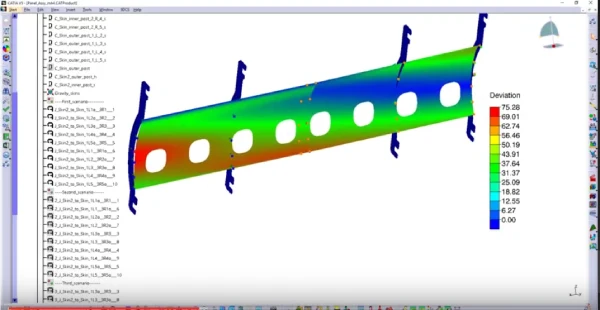
3DCS FEA Compliant Modeler, an add-on module to the 3DCS software solutions, utilizes FEA methods to accurately simulate variation of compliant parts and assemblies within the 3D Variation Analysis model.










Really fast
See how the material reacts to forces in the model and alters the amount of variation inherent in the system.
Use rubber bushings and washers. See how rivets and bolts affect aluminum sheets. Find out how environmental and operational heat deforms components.
Advanced applications for optimization will are covered in this webinar on-demand.
When flexible parts are in an assembly, or the effects of gravity and force affect the final assembly, 3DCS FEA Compliant Modeler can create more accurate results.
Create series of clamps and welds, and then release the clamps to understand how the parts will deform.
Learn more
Test different assembly sequences and processes such as welding, riveting, bolting and clamping to find optimal placements, order of operation and the effect on the assembly.
When welding, bolting, riveting or assembling parts, the order and the process can have as much of an effect on final results as the parts themselves. Riveting can stretch aircraft aluminum skin, assembling can bend and cause spring back, and bolting can warp materials. Simulate, test and determine the best order of operations and the impact these processes will have on your parts.
Determine how welding, bolting and connecting parts affects the dimensional characteristics of your product. Find out how the use of flexible materials like aluminum changes the way your product reacts to manufacturing processes.
How does pressure, force, and tooling affect the dimensional quality?
Determine the changes to your product based on constraints, forces, and operations.
We're closing the loop on quality at IMTS 2026 — Sept 14–19
Too many correction loops? The Manufacturing Quality Pack is now live.
OUT NOW : Inspection Flow is live. Centralize your metrology data and close the quality loop.