
Improving Fuel Efficiency in Aircraft Using Dimensional Management on Gap and Step Conditions
Presented at Aerodef 2016 by Donald Jasurda, Vice President Sales, DCS

Overview
- What is the Influence of Dimensional Variation on Fuel Efficiency
- Methods of Simulating Dimensional Variation
- Relationship Between Simulation and Reality
- Can Simulation Be Used to Accurately Predict and Reduce Variation?
- How to Determine Indirect Outputs From Variation Analysis?
Starting from the beginning: how does dimensional variation affect fuel efficiency?
Variation can increase Parasitic Drag, thus increasing the amount of fuel spent to travel the same distance. Parasitic Drag, as opposed to Induced Drag, includes Skin Friction Drag, Form Drag and Interference Drag.

This blog focuses on just Skin Friction Drag, and how dimensional variation can affect it.
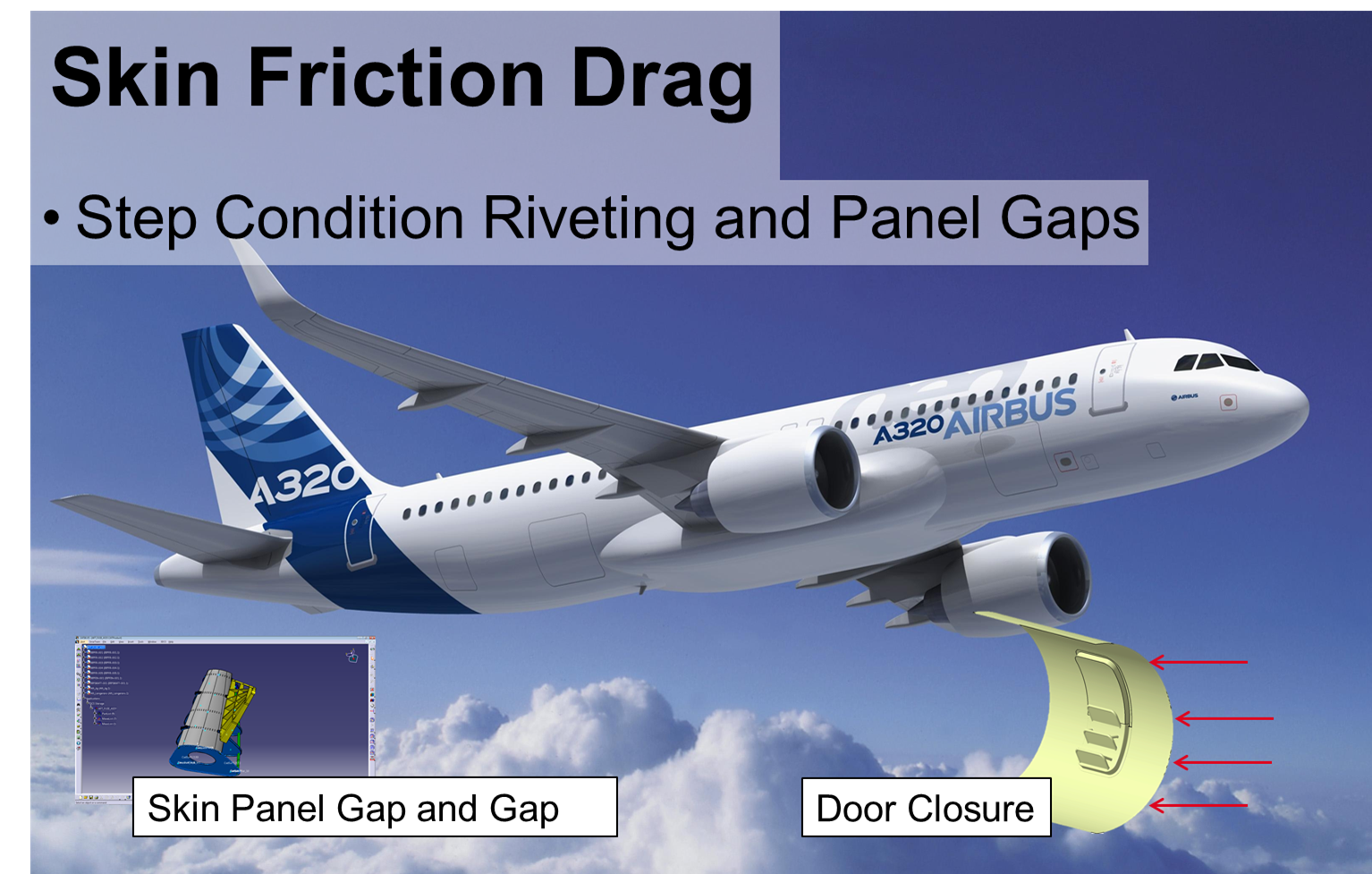
Drag and Fuel Efficiency
As noted, increasing drag increases the amount of fuel used over the life of the aircraft. This reduces the overall fuel efficiency of the plane. Different conditions, however, contribute to this value differently. A door’s closure and overall flush condition will have a smaller impact than a large gap on an airfoil.

Simulating Variation
Using CATIA and 3DCS, the engineering team simulated variation on an airfoil and tailfin model. Applying Monte Carlo Analysis, builds within given design specifications were virtually created and assembled.

Simulation Outputs
Simulation outputs included:
- Upper and Lower Spec Limit (adjustable by user)
- Standard Deviation
- Percent of Builds that Failed
- Range of Variation
- Primary Contributors of Variation (to that given measurement)
NOTE: Additional metrics (Pp, Cpk) were turned off for this study. For more information on 3DCS Analysis results, see http://www.3dcs.com/getting-started-3dcs-dimensional-analysis.html

Example Case Studies
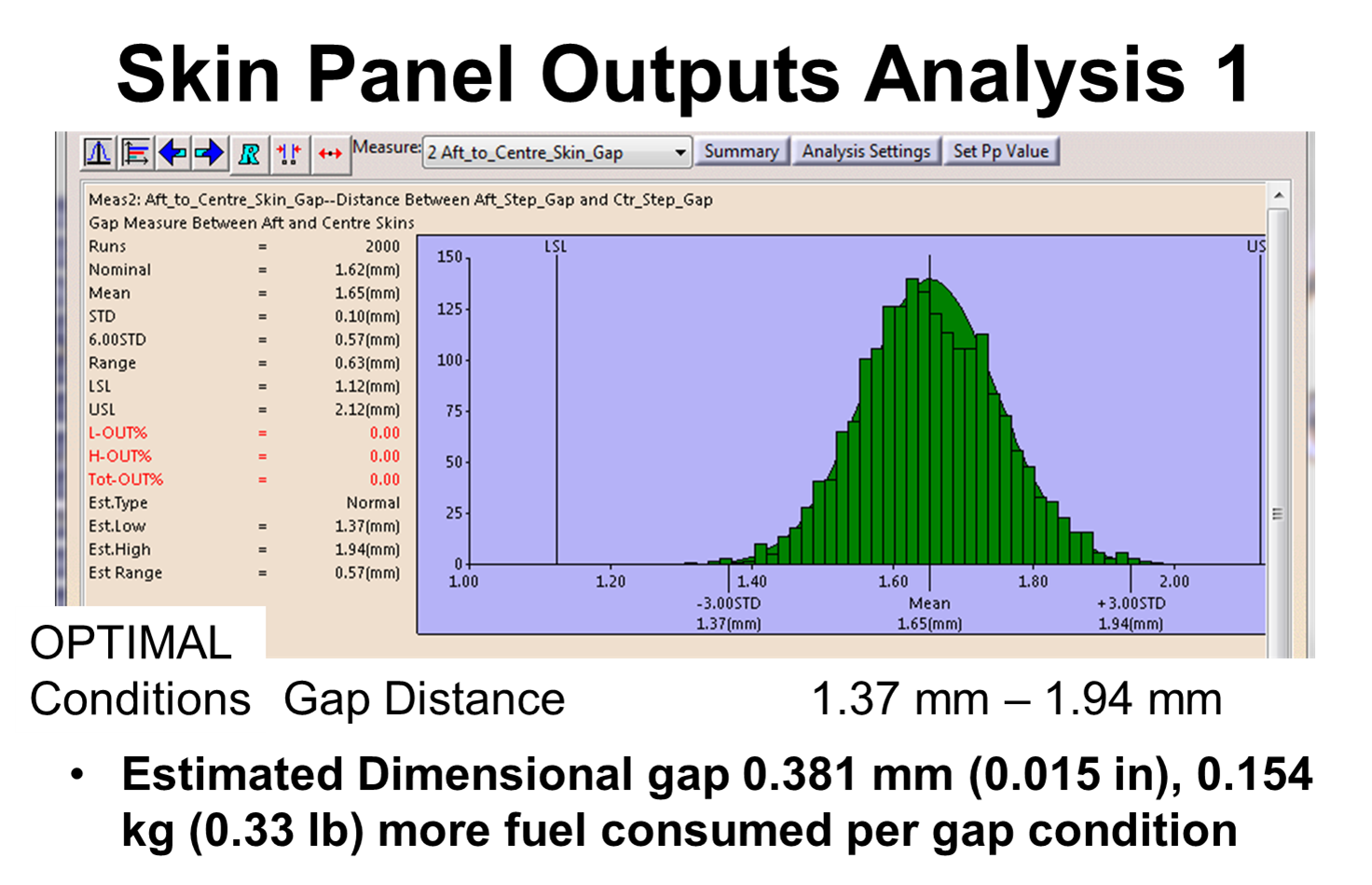
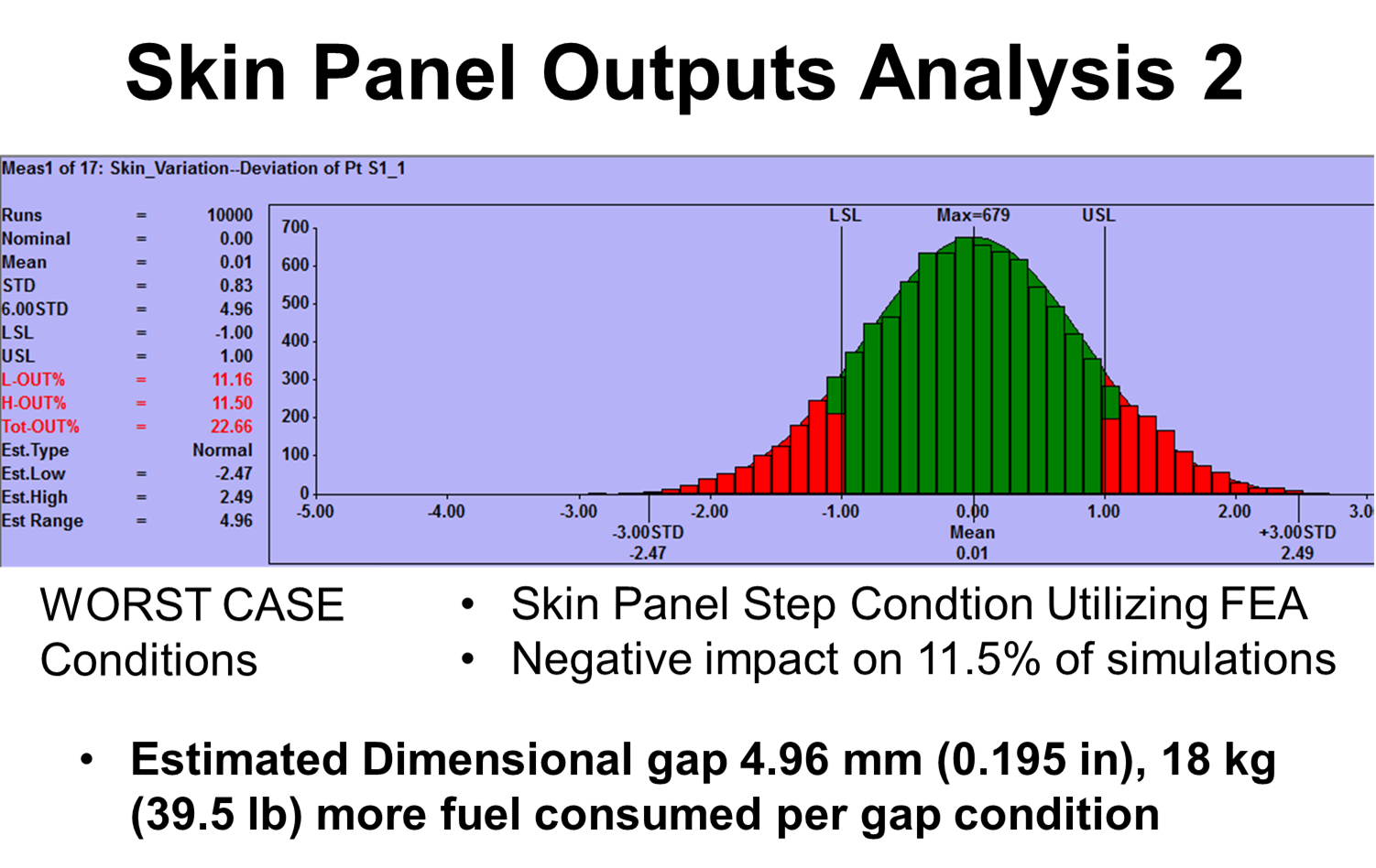
Two studies were completed to test the theory. Based on existing models, estimated effects of two condition sets were calculated.
These are based on a study of an Airbus A330 over 3000 miles, and are presented as examples of process, and not actual studies on the given product.
(Peeters, P. M.; Middel, J.; Hoolhorst, A. (2005). “Fuel efficiency of commercial aircraft: An overview of historical and future trends”(PDF). National Aerospace Laboratory. Retrieved July 6, 2014.)
Example 1: Skin Panel Gap Condition
Example 2: Skin Panel Worst Case
Determining Indirect Outputs from Dimensional Variation in 3DCS
3DCS Variation Analyst allows the user to input equations that can be used to determine indirect outputs from dimensional data. Fuel Efficiency is one example of an indirect output. With the aid of Aerospace Engineers and a complete study, this process can deliver more complete results.
Taking Simulation Farther: How Close is Simulation to Reality?
It is often asked, how close are your simulations to reality?
This of course is based on how much effort went into the simulation. A basic simulation using rigid body moves can give quick results with relatively good accuracy (approx. 70%). In order to get more accurate results, more involved simulation is required, such as incorporating flexible parts and Finite Element Analysis.
Learn more about Finite Element Analysis and 3DCS by viewing the 3DCS Webinar: http://mkt.3dcs.com/compliant-modeler-finite-element-analysis-fea-webinar-on-demand-part-3
Basic Simulation
– Rigid body moves
– Quick Results
– Lower accuracy
FEA Simulation
– Compliant moves
– Longer analysis
– Higher accuracy
– Requires more technical expertise
Summary
- Variation Affects Fuel Efficiency By Increasing Parasitic Drag
- Simulation Tools Can Accurately Predict Variation
- Using Simulation Tools, Variation Can Be Better Controlled to Improve Fuel Efficiency in Aircraft
Questions? Contact DCS to learn more
References:
- http://adg.stanford.edu/aa241/drag/skinfriction.html
- http://flightshield.com/docs/Boeing%20Report.pdf
- http://www.experimentalaircraft.info/articles/aircraft-drag-reduction.php
- https://en.wikipedia.org/wiki/Lift-induced_drag
- http://webfiles.ita.chalmers.se/~chernora/files/MJahanmiri_AircraftDragReduction.pdf
- http://commons.erau.edu/cgi/viewcontent.cgi?article=1034&context=ijaaa
- http://adg.stanford.edu/aa241/drag/skinfriction.html
- http://mail.tku.edu.tw/095980/drag.pdf
- https://www.hondajet.com/Content/pdf/tech_papers/Journal_of_Aircraft_Vol42_No3_P755_P764_HondaJet.pdf
- https://gcep.stanford.edu/pdfs/ChEHeXOTnf3dHH5qjYRXMA/10_Browand_10_11_trans.pdf
- https://en.wikipedia.org/wiki/Fuel_economy_in_aircraft
- http://www.skybrary.aero/index.php/Parasite_Drag
- http://illumin.usc.edu/252/drag-reduction-the-pursuit-of-better-fuel-economy/